The agency landscape has fundamentally shifted. While 81% of marketing agency owners are banking on revenue expansion by 2026, the reality is that traditional growth methods are hitting a wall. (Source: Agency Analytics)
The solution is not more of the same. It lies in building more agency partnerships, ergo, building relationships outside your agency and understanding what can help you grow. Be it by outsourcing talent or services. This is how Agencies grow. Agencies that collaborate with the right partners are not just staying alive, they are growing faster and more profitably in a way pure organic growth cannot match.
In this guide I will show you exactly how you can leverage these Partnerships to take your Agency Growth to the next level.

What Are Agency Partnerships?
Agency partnerships help you grow without adding big costs or competing on price. Instead of trying to do everything yourself, you team up with other agencies that bring skills or services you don’t already have. You both stay independent, but together you create more value for your clients.
With the right agency partnerships, you can offer a wider range of services without needing to do all the work in-house. This helps you respond faster to client needs, win bigger clients, and keep them for much longer, all while keeping your overhead low. It’s a win-win for both the parties involved!

Types Of Partnerships
1. Tool and Software Partnerships
This kind of partnership involves team-up with companies that provide software or tools your clients need. Often, you can resell these services under your own logo (white-label) adding additional value without needing to become a software expert yourself.
For example, instead of building your own email platform, you can resell a tool that already exists. Your clients appreciate having everything in a convenient, all-in-one package without needing to piece together their own solutions. This kind of partnership typically brings in 10%–20% additional annual revenue for many agencies, which acts as a nice boost with high margins.
2. Service Partnerships
This kind of collaboration lets you team up with companies that specialize in services you do not provide yourself. This lets you handle bigger and more complex campaigns without needing to grow your team or invest in additional resources.
For example, a PPC (pay-per-click) agency might team up with a conversion rate optimization expert to help their clients get more conversions without losing control of the overall strategy. Subcontracting lets you ease your workloads during busy periods without needing to hire permanent team members. Joint ventures enable you to go after bigger clients by combining your expertise, resources, and team.
3. Reseller Partnerships
Reseller partnerships are a great way to grow without adding additional team members or overhead. This involves sending clients back and forth with related companies or reselling their services alongside your own, adding additional profits while strengthening relationships.
Let’s say you run a digital marketing agency that focuses on SEO and content marketing, but your clients often need help with pay-per-click (PPC) campaigns. Instead of hiring an in-house team of PPC experts, you form a reseller partnership with a PPC-focused agency. When your clients need PPC services, you sell them under your own brand, adding a margin, while your PPC partner handles the delivery. At the same time, your PPC partner refers clients back to you when their clients need SEO or content marketing.
With Synup you grow through reseller partnerships by making it easy to manage and deliver additional services alongside your own. It helps you oversee listings, reviews, and reputation management for your clients, adding extra value by freeing up your team’s time and improving productivity and profitability.
4. Client-Based Partnerships
Client partnerships enable you to grow alongside your clients, tying your profits directly to their profits. This might be through a revenue-sharing, equity, or pay-for-performance model. The more your clients succeed, the more you succeed with them.
Instead of charging a flat fee, you might take a small percentage of sales that come directly from your campaigns. Co-marketing initiatives whether through case studies, events, or collaborative content help raise both your profiles and bring in new business for everyone involved.
How Can You Build These Partnerships?
Step 1: Define Your Partnership
Set clear goals: Start by figuring out what you want from the partnership. Are you looking for additional revenue streams, expansion into a new market, adding a new service, or reducing your delivery costs?
Evaluate your current situation: Analyze your own capabilities. Where are you strong, and where do you need help?
Research and shortlist partners: Analyze the market and your competitors to find companies that align with your goals and can fill your gaps.
Step 2: Choosing a Partner
Create a due-diligence checklist: This should include financial stability, operational capacity, cultural fit, client base, and industry credibility.
Check compatibility closely: Consider not just financials but also interpersonal relationships, communication style, and shared values.
Assess finance and operations: Analyze financial reports, operational processes, delivery timelines, and resources.
Step 3: Creating a Structure
Define legal terms clearly: Create a clear agreement that covers roles, responsibilities, revenue sharing, intellectual property, conflict resolution, and exit conditions.
Agree on revenue and incentives: Design a pricing or commission structure that’s fair for both sides and rewards desirable outcomes.
Set performance metrics: Identify key performance indicators (revenue, customer satisfaction, delivery timelines, number of referrals) that will help you track progress.
Step 4: Implement and Launch
Onboard with clarity: Start strong by developing clear onboarding materials, training sessions, or process guides. Begin with small, low-risk projects to foster trust.
Establish communication norms: Set up a clear communication calendar, preferred tools, and escalation procedures for issues or bottlenecks.
Activate joint go-to-market efforts: Create co-branded marketing materials, case studies, or sales decks. Develop a clear plan for generating new business together.
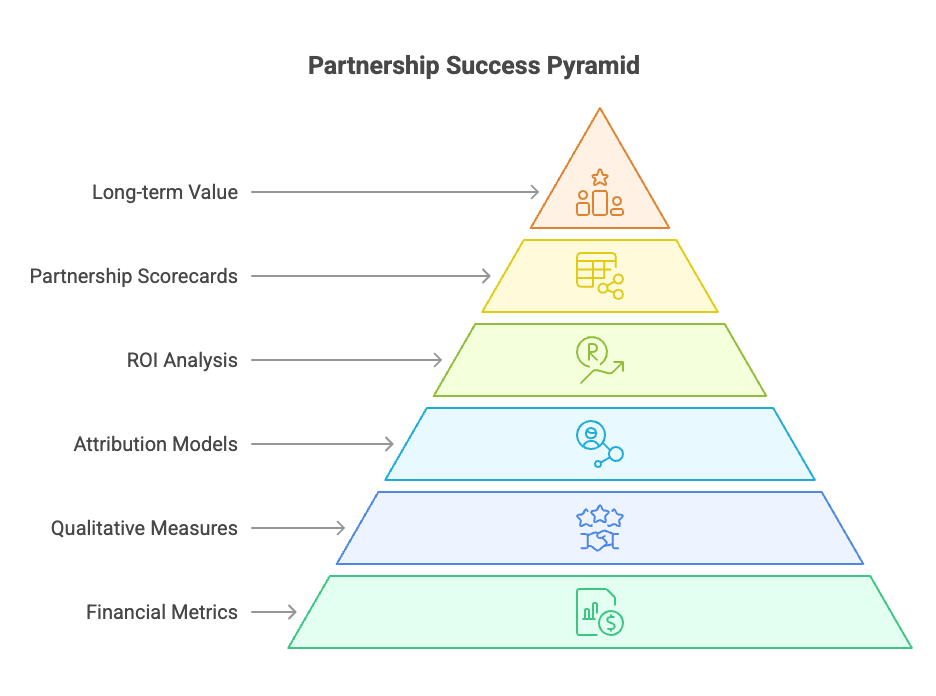
How To Measure What’s Working & What’s Not
When you are growing your agency through partnerships, you need a clear way to track whether those partnerships are delivering real results. Here are the most important metrics you should track:
- Revenue Attributed to Partnerships
- Number of Referral Leads or Deals Closed
- Client Acquisition Costs (CAC) Reduction
- Conversion Rate of Partner-Sourced Leads
- Client Lifetime Value (CLV) From Partners
- Co-marketing Deliverables Completed
- Renewal or Repeat Business
- Overall Profit Margin on Partner Deals
In Conclusion
Agency Partnerships can be a game-changer for your agency. They help you reach new clients, grow faster, and become more profitable, all without adding heavy financial or operational strain. When you team up with the right partners, you’re able to share resources, fill gaps in your services, and bring greater value to your clients.
FAQs
How do companies benefit from partnerships?
Partnerships help companies grow faster, reach new clients, and add additional revenue; all without adding heavy overhead or growing their team. They let you do more with less.
How does an agency play a role in partnerships?
An agency can connect, collaborate, and enable partnerships by matching clients with the right partners or adding their own services to make the relationship more profitable for everyone involved.
How does a partnership business grow?
A partnership business grows by combining resources, sharing expertise, and tapping into each other’s networks, turning relationships into a powerful way to scale together.
How can you benefit from establishing partnerships?
Creating strong partnerships lets you reach new clients, fill gaps in your services, increase profits, and make your agency more resilient in a changing market.